
She's a river

Sometimes I start these things and there are so many directions I could go in, I freeze. The multitude of stories we all have — which ones should I choose? It feels like a big river, with infinite possible tributaries to go down.
I spent the other night in Brooklyn, along with my friend J, at our friend C’s new apartment. The three of us went to high school together; there are those stories. We lived blocks from each other in the Village in our twenties: stories. We met up at a house in California this past summer: stories. Put us together in a sunlit room on a fifth floor in Carroll Gardens, and the stories seem thick enough to fog up the windows.
In Brooklyn, we walk down Court Street with C’s little dog Scarlett. Scarlett has been proscribed a teeny amount of sedative by her vet, as she is elderly and has just made a cross-country transition from L.A. We pass the writer Joanna Goddard walking the opposite direction with her son, and it seems a good omen seeing her in the wild, given that she’s a fixture in Brooklyn for a certain type of blog reader (us), and here she is, out here as advertised, and here C is too, fresh flowers in a vase on her kitchen counter, curtains hung, sheets on the beds.
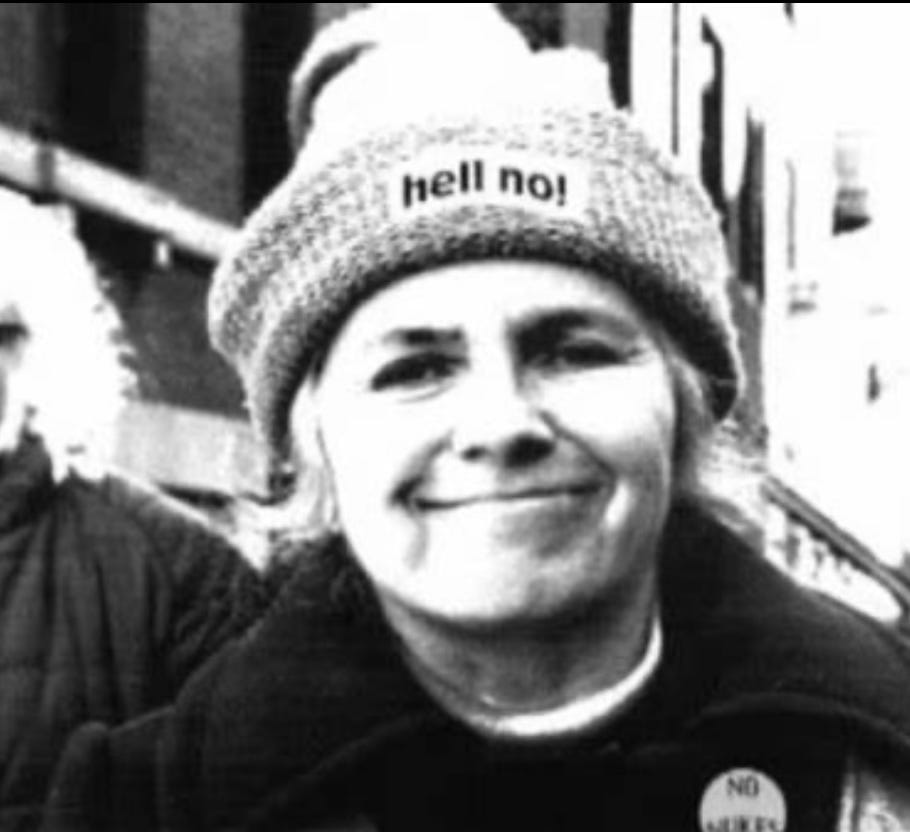
Some tributary could shoot off right here about running into writers in New York. I could tell you about the time I ran into Grace Paley in front of the Jefferson Market Library. That building was formerly the Greenwich Village Women’s House of Detention, and Grace Paley had been incarcerated there for a week in 1970 for protesting the Vietnam war, and wrote a hilarious and iconic piece about it. The security at the House of Detention was so lax that the families of the jailed could gather outside in the place RIGHT WHERE I WAS STANDING WITH GRACE PALEY THIRTY YEARS LATER to throw loaves of bread and books from the sidewalk up to the outstretched hands of the women inside. I saw Grace Paley before she saw me, walking slowly, regally, a small smile on her lips, white hair an unmistakeable corona around her nutlike face, proceeding across Sixth Avenue on the arm of a young man who she introduced as her grandson when I stopped her, and she received my greeting like a petal at her feet and paused to chat before moving along. Sightings of famous people confer something on us in cities chock full of luminaries, making us feel that much more a part of the great project. Should I describe the kerfluffle around John Kennedy Jr. I was once part of on lower Fifth Avenue — like that scene with the Queen’s motorcade in Mrs. Dalloway — or Claudia Schiffer choosing bananas as carefully as if she were choosing her engagement ring in the fruit section at Balducci’s? The framed faces on stands in front of Engine Company 18 we saluted with held breath for years after 9/11 as we passed them by, celebrities of no one’s choosing? That’s a different tone. Where were we again?
The high school J, C and I went to was a short walk through the woods to the Nashua River, on which crew boats rowed up and down. Carroll Gardens fronts the East River, which empties into Upper New York Bay, which flows into the Atlantic Ocean. Grace Paley processed toward the Hudson on the day I clasped her hand. Headed west.
C recently sent me a song by Patty Griffin called River. In high school, I made her a mix tape, with a part on it where Meryl Streep read from The Velveteen Rabbit about the Skin Horse becoming Real. C is an actor. Meryl is an actor who was reading a book. J is an editor and a writer. J edited my book. J learned to play guitar in high school, like Patty Griffin does, and this summer we all lay together on Carbon Beach — minus Meryl and Patty of course. If the Skin Horse had been a woman, would that speech to the Boy have been different? I hope not. I hope she wouldn’t have lamented her faded beauty or compared herself to a less loved but better-preserved Skin Horse. A Skilf.
Isn’t she a river?
She doesn’t need a diamond to shine.
Patty’s river is a woman. Leon Bridges’ river is for baptism. Joni wants to skate away on hers. So many rivers, so little time.
Down another tributary, you’ve got the koi. When I went to California this summer I guess you could say I was feeling a bit Scarlett-like, as in not young or entirely oriented. My sedative was the house I cared for, at the top of the canyon, where I opened the doors early each morning to mountains as far as I could see, and an Edenic garden bursting with fruit trees, flowers, succulents, hummingbirds, with a koi pond into which I was charged with tossing fish food twice a day. It was like a want ad that Eve would answer. I wrote, watered the trees, hiked, did yoga on a wide wooden platform, and by the time J and C came, I hadn’t laid eyes on the fish — I guessed there were about twenty five of them living in a stone basin no bigger than a refrigerator on its side — in two days. I’d called and texted the home’s owners to let them know, but they didn’t seem concerned, and said the fish were good at hiding and would emerge in time. Mind you, these people are yogis and about the most beatific folks you could encounter on planet Earth, so I was both comforted and, I admit, slightly distrustful of their perfect calm. Surely I’d done something wrong. C, J and I sat at the outdoor table and speculated: maybe koi were valuable. Had there been a heist? We peered into the basin, shaking the fish food bag and cooing flirtatiously. After five agonizing days of no sightings, a technician came to service the tank and discovered they’d fled deep into a pipe that fed into the basin, probably in fear of a crane that had landed nearby. They were alive; I wouldn’t be banished from the garden after all.
We went for a hike one day at Eagle Rock, but it was so hot we turned back. We talked half the night and drank wine and ate pizza and had to tell some stories several times in order to get them right, or get them fully out. This is a great, long labor among friends.
Back in the Brooklyn apartment, after dinner, Scarlett dozing on the sofa, C warned us the traffic outside might be loud enough to keep us awake that night, as her place isn’t far from the BQE. She needn’t have worried, but I did wake up at some point anyway and went into the living room so I wouldn’t bother J. Outside, the cars sounded like a current, like waves.
In Topanga, C told us one of the tricks her favorite director liked to teach, to relax his actors and keep them in the present while delivering lines. You were supposed to repeat “fish” in the back of your mind, like a mantra, a light mental focal point to hang onto.
The fish were in the pipe.
A river is a woman.
Real is a thing that happens to you, slowly at first, then fast, then over and over.
Okay, so now that I have established there are many directions to go in, it’s way past time to pick one.
That day on Carbon Beach, while the three of us were walking, I told a true story. It involved me freezing — my child in the waves a few summers before, a good swimmer, but slight. I watched her, my hand over my eyes like a visor, trusting in her ability, but aware that the optics weren’t good. The waves looked like they could overwhelm her. A family member came up and stood next to me, watching too. She was nervous. Was my daughter okay? The question made me hesitate. Maybe she wasn’t? And here’s the shameful part: the family member could see in my hesitation that not only was I suddenly unsure whether my child needed help, but that I was terrified to dive into the water myself. I’ve always feared waves, and hadn’t yet activated the superhero mode mothers are supposed to activate when in comes to extracting their kids from physical danger. The mother who can lift a car — I always thought I was her, but in that split second, I was exposed as chickenshit when it came to rough ocean. The family member dove in herself — everything was okay, but she’d had the courage I lacked in that half-blink of an eye, and it gutted me so deeply I’d never spoken about it to anyone.
Wow, C said. That is an amazing story.
You definitely would have gone in, J said, if you had to.
I can picture that so vividly, it’s like we were there with you, C said.
And M was definitely fine, J said. She’s really strong.
Real is a thing that happens to you over and over. Love does it.
*
Yoyo Ma posted this on his Instagram the other day:
I’ve spent decades trying to get this piece [Bach’s Cello Suite No.1] right. At some point, I found a way in: in the same way that a river begins far before we meet it, I imagine this music starting long before I play the first note; I just have to join it. Like the river, the music is always flowing, and like the river, it’s always changing. All I have to do is picture a river, feel its energy, get into its flow, and follow it.
*
At breakfast in Carroll Gardens, C tells us another story about another beach starring another daughter — hers. This one full of ceremony and love. Love in the water.
*
Rivers are old. Their stories predate ours: what a comfort. I think, in the end, this story wants to be about God’s great, divine plan, which I believe in. Some skein of infinite tributaries that fan into ocean and flow in the same direction. We find our put in, we follow, we float with the companions we’re gifted with. Baptize each other, forgive each other, skate away and back, shine on, connected.
I’ll say this: I wouldn’t have written anything, ever, if I didn’t think J might want to read it.
C is a bona fide luminary of New York.
And Scarlett is going to adjust like a champ to her new surroundings. She may be tired from her long journey, but once she makes a couple of good friends, she’ll be fine. Plus in New York, there’s a story around every corner, and plenty of ancillary side streets to wander down, astonished.
https://www.youtube.com/watch?v=m_bNyDrOeGs
Love is an army…and you are a General❤️
aw so sweet! Love this. I think you would have gone in too!